
There is a quiet, almost embarrassing assumption buried inside most corporate motivation programs – that people work like vending machines dispensing snacks. Insert money, press the right button, obtain the desired output. It feels logical. It even works, up to a point.
The problem is that employees are not vending machines, and the motivational statistics from 2025 and early 2026 make that clearer than ever. The coin-and-button model is why companies keep investing in the same incentive programs – and why those programs keep delivering diminishing returns.
The question HR teams, executives, and consultants keep returning to is deceptively simple: why aren’t employees motivated? The more uncomfortable version, the one data actually forces you to ask, is this: were they ever not motivated, or did we simply stop giving them reasons to be?
The distinction matters. If motivation is something people bring to work, then losing it is their personal failure. But if it is something that workplaces cultivate, or quietly destroy, then the numbers we are about to walk through are not a portrait of a disengaged workforce. They are a mirror. And right now, in 2026, that mirror is showing something uncomfortable.
The employee motivation numbers: How many people actually want to be at work?
Let’s start with the headline. Not the spin, not the press release version – the raw number.
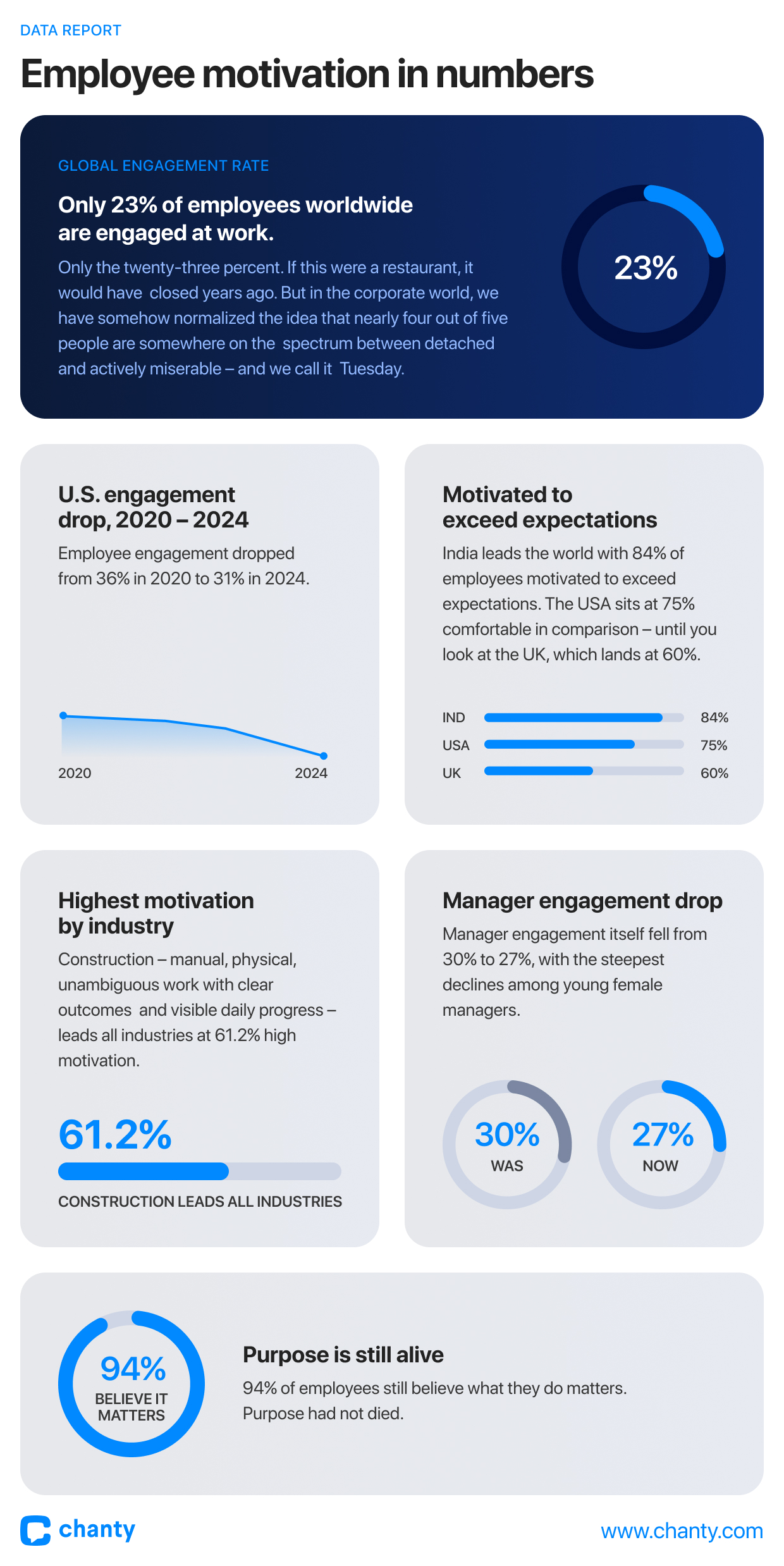
Only 23% of employees worldwide are engaged at work. Only the twenty-three percent. If this were a restaurant, it would have closed years ago. But in the corporate world, we have somehow normalized the idea that nearly four out of five people are somewhere on the spectrum between detached and actively miserable – and we call it Tuesday.
In the U.S., employee engagement dropped from 36% in 2020 to 31% in 2024. This is not a blip. It erases a decade of hard-won progress in exactly four years – think of it like a company’s share price: you spent ten years building it up, and then something fundamental shifts, and you are back where you started, staring at the chart, trying to figure out what went wrong.
Here is what makes the 2025-2026 motivation stats especially unsettling: the surface looks calm. Quit rates are down. Headcount is stable. Nobody is dramatically storming out of the building. Researchers at Perceptyx put a name to what is actually happening: “job hugging” – employees who are clinging to their positions out of economic anxiety rather than any genuine connection to the work. They are present, but at the same time, they are not here.
A few data points that add important texture:
- India leads the world with 84% of employees motivated to exceed expectations. The USA sits at 75% comfortable in comparison – until you look at the UK, which lands at 60%. An 11-point gap between two economies that consider themselves roughly comparable. That gap costs money, competitiveness, and innovation (PwC’s Global Workforce Hopes and Fears Survey 2025).
- Construction – manual, physical, unambiguous work with clear outcomes and visible daily progress – leads all industries at 61.2% high motivation. There is something worth sitting with in the fact that the sector where you can see exactly what you built at the end of the day consistently outperforms sectors where the output is abstract and screen-mediated.
- Manager engagement itself fell from 30% to 27% in 2024, with the steepest declines among young female managers. This matters because roughly 70% of the variance in team engagement traces back to the direct manager. When the managers lose motivation, everyone below them feels it – sometimes before anyone has a name for what is happening.
- 94% of employees still believe what they do matters. Purpose had not died. The problem is not that people have stopped caring about their work. It is that their workplaces have stopped caring about them.
The motivation crisis is not a purpose crisis. It’s a delivery crisis – a gap between what employees arrive ready to give and what the organization actually creates conditions for.
What’s killing the light – the anatomy of demotivation
Every experienced office worker knows the specific, slow deflation that happens when something goes wrong at work. It’s not usually a dramatic event. It’s like a series of small, quietly demoralizing moments that compound over time like compound interest – except instead of accumulating wealth, you are accumulating the quiet certainty that nobody is paying attention.
Here is what the data says those moments actually are.
The trust problem – or why the motivational speech isn’t working
Imagine being asked to give your best effort to someone you fundamentally don’t trust. Not because you are a bad person, necessarily – just because their actions and their words have stopped matching up. This is the working reality for roughly 80% of employees right now.
- Only 20% of employees say they trust their leadership.
- 92% say trust in leadership is directly important for their motivation.
The Effectory Global Employee Engagement Index makes the structural case: strong leadership increases alignment by 22.5%, retention by 20.6%, and productivity by 19.3%. These are not soft outputs – they are measurable results that flow directly from whether employees believe the person above them is competent, honest, and genuinely interested in their development. The uncomfortable implication is that most employee motivation programs are trying to solve a trust problem with a rewards mechanism – it’s like an organizational equivalent of buying flowers after breaking a promise.
What to do about it:
- Make manager development sustained, not one-off. Invest in coaching that teaches how to give honest feedback, recognize effort publicly and privately, and handle difficult conversations without retreating into vague corporate language.
- Create upward feedback channels. Trust is bidirectional; employees who can rate their managers anonymously – and see those ratings acted upon – report significantly higher engagement over time.
- Let the data speak at all-hands meetings. Employees who sense a gap between the leadership narrative and the internal reality check out long before they resign.
The recognition gap – when effort disappears into the void
There is a particular kind of professional loneliness that comes from working really hard on something, finishing it, and hearing absolutely nothing. Not even criticism – nothing. The project goes out, the task is done, and the quarter closes. And the silence is so complete that you start to wonder if anyone noticed. And then you start to wonder if it mattered. And then you stop wondering and just … do less.
This is not a metaphor. This is the mechanism by which 39% of employees currently feel underappreciated – and why 77% of them say they would work harder if they simply received more recognition. The data from the 2025 State of Employee Recognition Report adds a number that should be happening on the wall of every HR department in the world:
- Only 19% of employees receive meaningful recognition on a weekly basis. Those who do are 9x more likely to feel a strong sense of belonging
Weekly recognition is not about being lavish. It’s about frequency and authenticity. In many modern teams, this kind of recognition now happens inside the tools people already use to work together. A quick message in a team chat, a public thank-you in a shared channel, or a short voice note can replace the old annual recognition rituals. Platforms like Chanty make this kind of everyday acknowledgement visible across the team.
- 69% of employees who receive regular recognition report higher productivity. The ROI on a genuine, specific, timely acknowledgement is one of the highest-returning investments any manager can make – and it costs nothing except attention.
One counterintuitive finding worth flagging: CIPD’s evidence review on recognition found that while public acknowledgement motivates the recipient, it can simultaneously breed resentment among colleagues who were not named. The very act of singling out one winner can quietly demotivate the nine people who were not. This is not an argument against recognition – it is an argument for a much broader architecture of appreciation that doesn’t rely on scarcity.
What to do about it:
- Build recognition into the rhythm of work, not the calendar. A brief message from a manager that says “the way you handled that client call today was exactly right” does more than a framed certificate at the annual dinner.
- Encourage peer-to-peer recognition. Appreciation from a colleague carries a different kind of weight – it signals that the team sees you, not just the hierarchy.
- Be specific. “Great job this week” is a wallpaper. “The way you restructured the proposal around the client’s actual concern – that was smart thinking that changed the outcome” is something a person remembers for years.
The career ceiling – staring at a wall and calling it a view
Here is a question every manager should ask themselves: if one of your best people came to you today and asked, “Where is my career going in this company?”, could you answer it? Not vaguely. Specifically. Could you describe a real path, with real milestones, and real support?
Because 51% of employees are actively job-searching right now, because they cannot see any path forward where they are. And 94% say they would stay longer at companies that invest in their development. The math here is stunning: replacing an employee costs between 50% and 200% of their annual salary. The cost of a development conversation is approximately one hour of someone’s time.
The generational dimension makes it urgent: Gen Z and Millennials prioritize purpose-driven advancement – they want to grow into something meaningful, not just upward. Gen X and Boomers lean more toward stability. But across all four generations, the need to see a believable future at the company is consistent.
The burnout spiral – doing more with less, for longer, until something breaks
If you have worked through a period of understaffing – where someone left, and the workload got distributed without the headcount to match it – you know exactly what this section is about. The initial surge of effort feels fine, even noble. You are the one holding things together – the hero deserves recognition. Then six weeks pass, and you are still holding things together, and it does not feel noble anymore. It just feels heavy.
- 82% of white-collar workers report experiencing burnout
- 36% of employees face heavier workloads due to unfilled positions – 60% of those are burning out
- 77% of all employees experience work-related stress.
And Perceptyx flags something newer and more insidious: change fatigue. Perceptions of how organizational change is handled have declined for two consecutive years – even as the research now identifies change management as the single strongest predictor of employee engagement. Organizations are changing more and explaining it less, which is one of the most effective ways to make a workforce feel like furniture.
What to do about it:
- Audit workloads honestly when someone leaves. Distributing their tasks indefinitely without acknowledging the burden is not cost-saving – it is a quiet tax on the people who stayed.
- Communicate change before, during, and after it happens. People can handle most things if they understand why they are happening. The unknown is almost always worse than reality.
- Protect recovery time. Encouraging people to use their time off is not a productivity threat – it’s a productivity investment.
The remote and hybrid variable – when distance becomes a motivation problem
The demotivators described above exist in every workplace. But for more than half of the global knowledge workforce now operating in remote or hybrid arrangements, each one arrives with an amplifier attached.
Distance removes the ambient information that keeps people connected: the overheard conversation that tells you the project is going well, the hallway exchange that doubles as recognition, the visible body language that signals trust or tension before anyone speaks. When those micro-signals disappear, motivation requires more deliberate architecture. It doesn’t happen by default.
- Remote employees are 16% less likely to feel their manager cares about their well-being. Hybrid workers report the sharpest drop in belonging – down 7 points since 2023, according to the Qualtrics Employee Experience Trends report.
The irony is that remote and hybrid workers often have higher autonomy – one of the strongest motivation drivers in the research – and yet report lower overall engagement. The reason, according to Gallup’s analysis, is that autonomy without connection is isolating rather than empowering. You have the freedom to do the work. You just have no sense that anyone would notice if you stopped doing it well.
A few specific patterns the data identifies for distributed teams:
- Recognition is even more likely to fall through the cracks in remote environments. Managers who naturally give recognition through physical presence – a nod, a quick word after a meeting – often do not translate those habits into digital equivalents. Out of sight genuinely does mean out of mind, for recognition purposes, unless a deliberate system exists.
- Meeting overload has replaced the commute as the primary engagement drain for remote workers. Microsoft’s 2025 Work Trend Index found that unnecessary meetings are the top source of friction for hybrid employees – not the work itself, but the scaffolding around it that consumes time without creating connection.
- Onboarding is where remote motivation is most vulnerable. New hires who join a distributed team without intentional cultural integration take up to three times longer to reach full engagement than office-based counterparts. The motivation gap can be structural before the person has even settled in.
What to do about it:
- Design recognition explicitly for asynchronous environments. A voice message, a dedicated channel for acknowledging wins, a brief video note – these are not replacements for in-person appreciation: in distributed teams, they are the primary vehicle for it.
- Protect some meetings as connection time, not just task coordination. Teams that have a regular rhythm of informal conversation – even fifteen minutes of non-agenda time – consistently report higher belonging scores than those where every meeting is strictly functional.
- Give remote managers specific coaching on digital recognition habits. The skills that make a great in-office manager do not automatically transfer; the behaviours need to be explicitly learned and practised in a digital context.
What actually moves people – the science of real motivation
The good news is that motivating people is not complicated. It is just uncommon. The factors genuinely drive employees to bring their best to work are remarkably consistent across cultures, industries, and generations. They are also, almost universally, things that cost very little to provide.
The top five motivation drivers
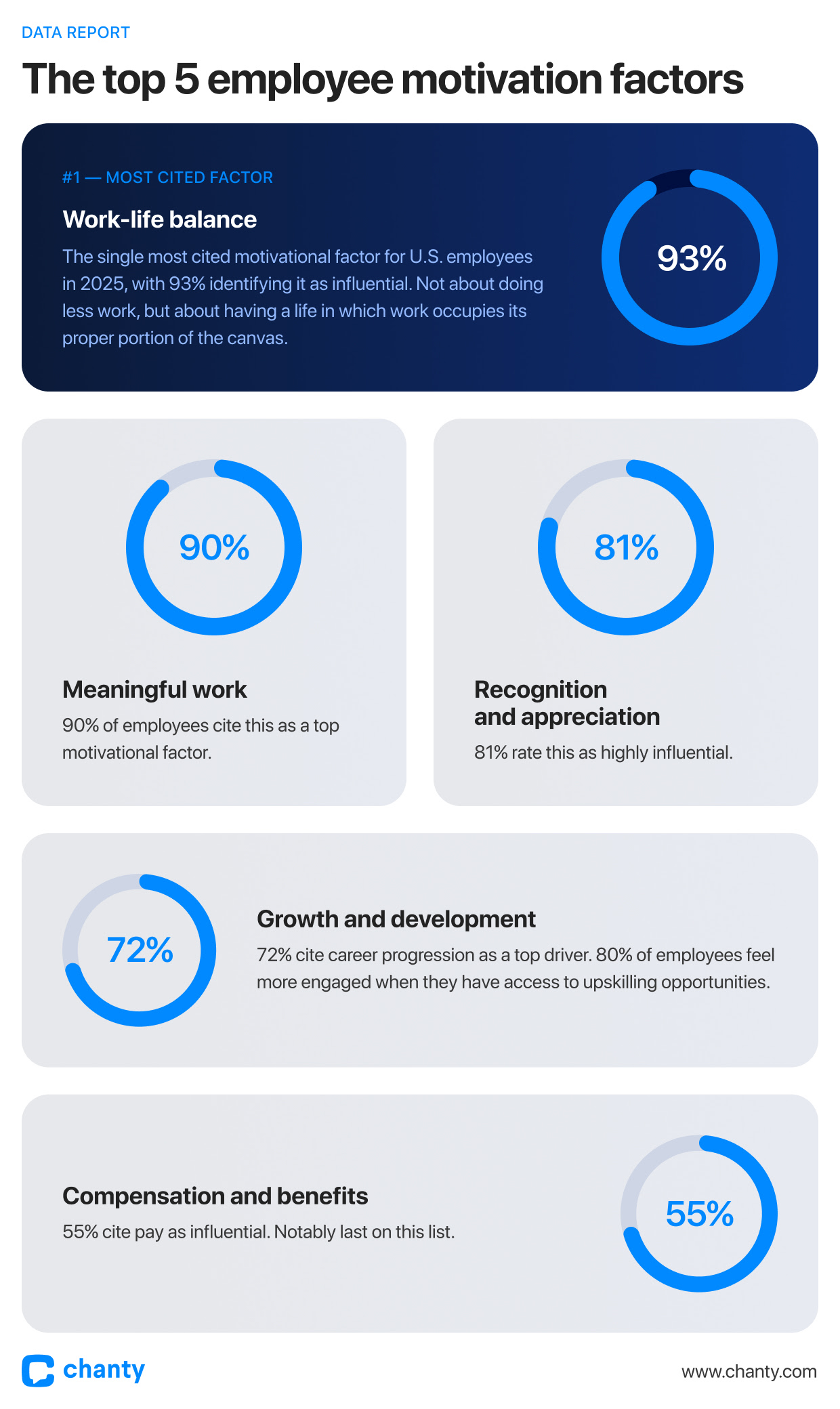
- Work-life balance – the single most cited motivational factor for U.S. employees in 2025, with 93% identifying it as influential. Not about doing less work, but about having a life in which work occupies its proper portion of the canvas.
- Meaningful work – 90% of employees cite this as a top motivational factor. Organizations that help employees understand how their specific role connects to outcomes that actually matter – to customers, to the mission, to something beyond the quarterly target – have a measurable engagement advantage.
- Recognition and appreciation – 81% rate this as highly influential. Motivational programs for employees built around consistent, specific, and timely recognition consistently outperform those centred on occasional financial rewards.
- Growth and development – 72% cite career progression as a top driver. 80% of employees feel more engaged when they have access to upskilling opportunities. In a world where AI is actively reshaping job requirements, learning access is not a perk – it’s reassurance that the organization intends to bring you with it into the future.
- Compensation and benefits – 55% cite pay as influential. Notably, last on this list. Necessary, but not the level that most organizations assume it to be when they reach for the motivational toolkit.
The compounding returns on these investments are extraordinary:
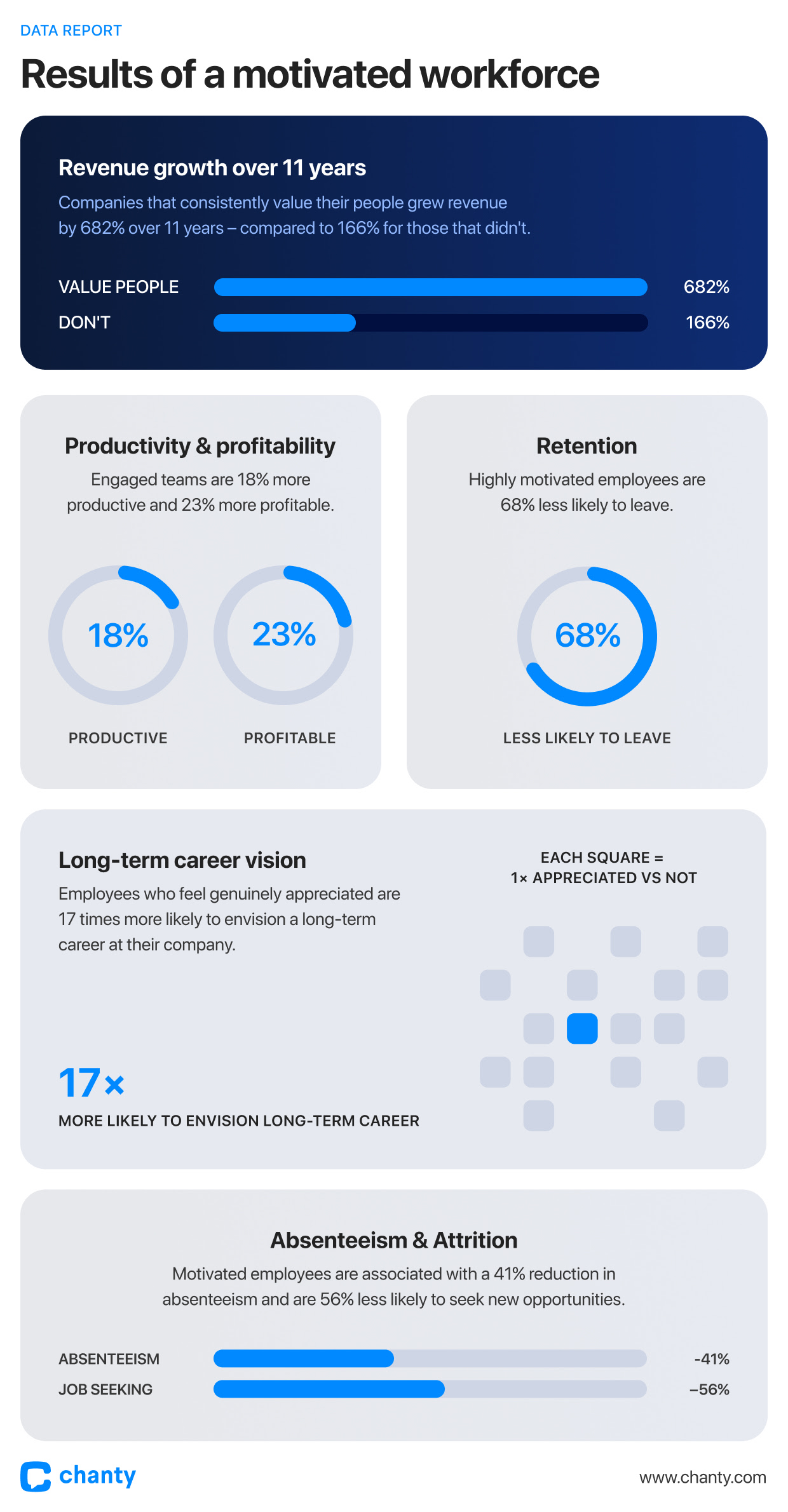
- Engaged teams are 18% more productive and 23% more profitable
- Highly motivated employees are 68% less likely to leave
- Companies that consistently value their people grew revenue by 682% over 11 years – compared to 166% for those that didn’t.
- Motivated employees are associated with a 41% reduction in absenteeism and are 56% less likely to seek new opportunities.
- AWI’s 2026 Engagement Report: employees who feel genuinely appreciated are 17 times more likely to envision a long-term career at their company.
The graveyard of good intentions – motivation programs that have stopped working
There is a specific kind of meeting that happens in organizations every few months. Someone pulls up a slide deck, the words “employee engagement initiative” appear on the screen, and a well-meaning program gets announced that almost everyone in the room can already tell will not work at all. The program launches anyway. Participation is mandatory. Three months later, it’s quietly discontinued.
Here are the usual suspects, and why they keep failing:
Generic financial incentives – pain for performance without understanding it
Money is necessary without a doubt. Nobody is arguing that people should work for free. Quota-based incentive structures optimize for exactly the behaviour the quota measures – and in doing so, quietly degrade everything the quota ignores. Customer support agents incentivized on tickets closed per day; close more tickets and care less about whether the problem was actually solved. Annual bonuses that fail to grow year-over-year can actively demotivate: employees who expected a certain figure and received less than they expected experience it as a concrete loss, not a reward. Loss aversion is real, and bonus programs that do not account for it end up doing the opposite of what they were designed to do.
Employee of the month – the accidental resentment machine
This one had a good run. But in 2026, the single-winner recognition model creates more problems than it solves. It assumes motivation is scarce – that there can only be one person worth recognizing in any given month. It pits colleagues against each other. And CPD’s evidence review adds a finding that should give every HR team pause: public recognition of one individual can simultaneously foster envy and resentment among colleagues. Only 22% of organizations report actually understanding what is driving disengagement among their people, which means most incentive programs, including this particular one, are being designed with very little information about the humans they are supposed to motivate.
Unlimited vacation – the policy that sounds generous but behaves stingily
The theory is beautiful. The practice is something else entirely. Without a culture that actively models and encourages time off – where leaders visibly take breaks, and nobody feels that leaving is a professional liability – unlimited vacation creates anxiety, not freedom. Employees take less time off than they would under a structured policy. The benefit exists only on paper, and the gap between the stated policy and the lived experience breeds a very specific kind of cynicism that is harder to undo than the original problem would have been.
The annual review as a sole feedback mechanism
Imagine receiving feedback on your driving exactly once a year. For 364 days, no one tells you if you are drifting into the wrong lane, if your speed is off, or if you are about to miss a turn. And then, on day 365, someone hands you a structured performance review. Employees are not waiting for praise anymore. The recognition data is unambiguous: regular, specific, timely acknowledgement is the baseline expectation. A once-a-year check-in does not substitute for a culture of continuous feedback – it simply arrives too late to change any of the behaviour it describes.
What is a characteristic of an effective incentive?
Incentive theory has been studied seriously since the mid-twentieth century, from Maslow’s hierarchy of needs to Herzenberg’s two-factor model to self-determination theory. What decades of research have established, and what the latest motivation stats continue to confirm, is that an effective incentive is rarely about the size of reward. It’s about the signal the reward sends – and whether that signal arrives in a way the brain can actually act on.
Based on the 2025-2026 motivation stats, an effective incentive has a very specific profile. Think of it as a quality checklist – a filter that every recognition or reward program should pass before it gets rolled out to real humans with real motivation on the line.
The 2026 incentive checklist
- Timely – recognition loses up to 80% of its motivational impact when delayed. The moment matters. A thank-you delivered a month after the fact is a historical document, not a motivator. The brain links effort to outcome most powerfully when the interval between them is short.
- Specific – it names the exact action being rewarded and explains why it mattered. “Great work this week” is ambient noise. “The way you de-escalated the client by acknowledging the problem before offering a solution – that is the approach that turns an angry customer into a loyal one.” gives someone a mental model they can apply again.
- Authentic – employees can feel the difference between genuine appreciation and programmatic box-ticking. Forced enthusiasm is worse than silence. Understated sincerity is more powerful than elaborate ceremony almost every time.
- Personalized – motivation is not one-size-fits-all. Some people are driven by public recognition. Others find it excruciating and would prefer a private word and an interesting new responsibility. Financial incentives outperform for employees whose basic compensation needs feel unmet – and underperform for those whose primary driver is autonomy or mastery. Effective motivational incentives for employees account for this variation.
- Connected to purpose – Harvard Business School research shows that even well-designed financial incentives underperform when they are not linked to mission and values. People need to understand not just what they are being rewarded for, but why the behaviour matters to the organization’s mission.
- Equitable and transparent – fairness is the foundation of trust, and trust is the foundation of motivation. Incentives perceived as arbitrary or inconsistently applied actively corrode the motivation they were designed to build. Justice perceptions – whether the process feels fair – are as important as the actual reward.
- Team-reinforcing, not just individually competitive – motivational programs that pit people against each other corrode the collaboration that makes the whole greater than the sum of its parts. Programs that build collective wins alongside individual ones consistently generate more durable engagement.
Properly constructed incentive programs can enhance employee performance by up to 44% and motivate up to 66% of employees to stay. The gap between organizations that get this right and those that don’t isn’t a budget gap. There is a gap in commitment to understanding what their people actually need.
The loneliness nobody mentions in the strategy deck
Here is something the data keeps circling back to, in study after study, from Qualtrics to Gallup to Culture Amp: the most motivated employees are not simply the ones who are paid better or recognized more. They are the ones who feel connected to their team, to their purpose, to the sense that their voice can be heard and that their absence would be noticed.
Workplace loneliness is a genuine motivation killer – and it is one of the least discussed. It tends to arrive quietly, especially in remote and hybrid environments where a day can pass without a single real conversation, where Slack messages pile up but feel transactional, where nobody asks how you are doing and means it.
The Qualtrics 2026 report puts it plainly: “the key is connection.” Employees want to feel connected to their organisation and what it stands for. 65% of employees say they want more communication with their managers. Not more emails, not more all-hands meetings – more actual human communication, the kind that goes in both directions and occasionally surprises you.
Good communication is not a soft supplement to good management. It is the infrastructure through which every other motivational driver gets delivered. Recognition travels through communication. Trust is built through communication. Feedback, growth visibility, psychological safety – all of it lives in the quality of daily conversations between people.
Motivation doesn’t collapse because people stop caring. It collapses because the friction of disconnection accumulates until it outweighs the effort of trying.
The statistics in this article are not comfortable reading. But they are honest. And honesty is, it turns out, exactly what both motivation research and effective communication have in common: the willingness to say what is true, even when the easier option is to say what sounds good.
The path forward is not so complicated. It’s just uncommon. Recognize more, listen more, build trust, invest in growth, create that connection, and give people something worth coming back for on Monday morning.